
Account takeover fraud rarely announces itself anymore.
There’s no dramatic breach. No alarms blaring. No obvious red flags at the login screen.
Instead, the system lets the person in — because everything looks right.
The device feels familiar.
The behaviour doesn’t seem unusual.
The account has history.
That’s exactly why account takeover fraud has become one of the hardest risks for digital businesses to control today. Not because systems are weak — but because trust is often misplaced.
What Account Takeover Fraud Really Is
At a basic level, account takeover fraud happens when an unauthorised person gains access to a legitimate user’s account and misuses it.
But that definition undersells the problem.
Modern account takeover isn’t about breaking security. It’s about inheriting trust.
The attacker doesn’t create a fake identity — they quietly step into a real one.
That’s why traditional defenses, built to detect “unknown” users, often fail. The risk doesn’t come from someone new. It comes from someone who feels familiar.
How Account Takeover Actually Plays Out in Real Systems
In theory, account takeover starts with stolen credentials.
In practice, it unfolds across multiple touchpoints.
Credentials may be acquired through phishing, reused passwords, SIM swaps, or social engineering. But once access is gained, the real challenge begins — for the organisation.
Because the login often succeeds cleanly.
No failed attempts.
No suspicious IPs.
No obvious anomalies.
From the system’s point of view, this looks like a returning user doing normal things — until damage quietly accumulates.
The Invisible Moments Where ATO Slips Through
Most organisations focus heavily on login security. But account takeover rarely causes harm at login.
It causes harm after access is granted.
Common blind spots include:
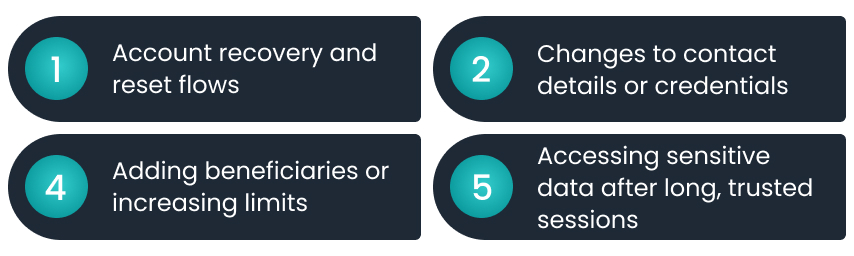
- Account recovery and reset flows
- Changes to contact details or credentials
- Adding beneficiaries or increasing limits
- Accessing sensitive data after long, trusted sessions
These moments carry real impact — yet often rely on weaker or one-time checks.
This is where account takeover stops being a security issue and becomes an identity continuity problem.
Identity Fraud vs. Account Takeover: Why the Difference Matters
Identity fraud and account takeover are often discussed together — but they require different thinking.
- Identity fraud involves creating or using a false identity.
- Account takeover involves hijacking a legitimate one.
Controls designed to stop fake identities don’t always stop hijacked ones.
When the identity already exists in your system, has history, and behaves plausibly, the risk profile changes completely.
This distinction matters because many organisations apply the wrong controls to the wrong problem.
Who Is Most Exposed to Account Takeover Today
Account takeover is no longer limited to banks or consumer apps.
Any organisation that offers:
- digital onboarding
- stored value or sensitive data
- self-service account recovery
- low-friction user journeys
is exposed.
Ironically, businesses that invest heavily in customer experience are often more vulnerable. Faster access, fewer interruptions, and persistent sessions improve usability — but they also increase the cost of misplaced trust.
Scale amplifies this risk. The more users you serve, the harder it becomes to notice when something quietly changes.
Early Signals Teams Often Notice Too Late
Unlike classic fraud, account takeover doesn’t always trigger clean alerts.
Instead, warning signs surface indirectly:
- Support tickets that don’t quite add up
- Users reporting changes they didn’t make
- Sudden disputes or reversals
- Behaviour that feels “off” but not rule-breaking
By the time these signals converge, the account has often already been misused.
This delay is costly — operationally and reputationally.
The Real Impact of Account Takeover
Financial losses are measurable.
Trust erosion is not.
After an account takeover:
- Customers hesitate before transacting again
- Support teams absorb emotional fallout
- Risk teams tighten controls reactively
- Product teams face pressure to add friction
Over time, the organisation becomes more defensive — and less confident in its own systems.
That’s a steep price for something that often went unnoticed at the start.
Why Traditional Defences Are Struggling to Keep Up
Most account takeover prevention relies on:
- static credentials
- one-time verification
- rule-based alerts
These approaches assume identity is stable once verified.
But digital identity isn’t static.
People change devices. Numbers change. Behaviour evolves.
When trust is granted once and remembered indefinitely, attackers don’t need to outsmart systems — they just need to wait.
Rethinking Account Takeover Through Continuous Identity Assurance
Leading organisations are shifting how they think about identity.
Instead of asking:
“Is this user verified?”
They ask:
“Does this interaction still make sense for this identity?”
This means:
- Verifying identity at moments of impact, not just entry
- Using contextual signals instead of rigid rules
- Treating trust as conditional, not permanent
This approach reduces false positives without ignoring real risk — and aligns security with user experience instead of working against it.
Platforms like Gridlines are built around this idea: enabling organisations to strengthen identity checks where they matter most, without adding unnecessary friction everywhere.
Closing Thought: The Question Worth Asking
Account takeover fraud isn’t going away.
It’s becoming quieter, subtler, and more patient.
The real question for organisations isn’t:
“How do we block every attacker?”
It’s:
“Where are we trusting identity for too long?”
Because in a world where the wrong person can feel familiar, identity needs to stay alert — even when everything looks normal.






Leave a Reply