
Identity verification market in India is going through a quiet but decisive shift.
What was once seen as a regulatory obligation — something teams built just enough of to pass audits — is now becoming core digital infrastructure. It sits at the centre of how organisations onboard users, manage risk, earn trust, and scale responsibly.
This shift isn’t theoretical. It’s already visible across banking, fintech, marketplaces, telecom, and even non-financial digital platforms. Identity is no longer just about who someone is. It’s about how confidently a system can trust that identity over time.
And that’s exactly why India’s identity verification market is entering a phase of rapid expansion.
A Market That’s Growing Because It Has To
India’s identity verification market is projected to grow at a strong double-digit CAGR over the next decade, with estimates suggesting it could cross USD 2 billion by the early 2030s, growing at roughly 15–20% annually.
Source
But this growth isn’t being driven by hype or novelty.
It’s being driven by necessity.
Digital adoption in India has outpaced the systems originally built to verify trust. Transactions are faster, onboarding is remote, fraud techniques are more sophisticated, and regulators expect tighter control — all at the same time.
Identity verification has had to evolve from a static checkpoint into a living system.
Why India Is a Unique Growth Market for Identity
Few countries combine scale, speed, and regulatory complexity the way India does.
On one side, you have mass digital adoption:
- UPI moving billions of transactions
- Mobile-first onboarding across services
- Credit, insurance, and investments going fully digital
On the other, you have a regulatory environment that is increasingly explicit about accountability:
- Strong KYC and AML expectations
- Clear definitions of responsibility for identity misuse
- A growing emphasis on privacy, consent, and data minimisation under DPDP
Between these two forces sits identity verification — absorbing pressure from both ends.
Regulation Isn’t Just a Driver. It’s a Design Constraint.
Much of the market’s expansion can be traced back to regulation — but not in a simplistic way.
KYC and AML norms don’t just require identity checks. They demand:
- Accuracy
- Auditability
- Consistency
- Fairness
DPDP adds another layer:
- Consent must be explicit
- Data collection must be purpose-bound
- Retention must be justified
- Exposure must be minimised
This means identity verification systems can’t just work.
They must work predictably, explainably, and responsibly.
As a result, organisations are moving away from fragmented, ad-hoc checks toward structured verification stacks that can stand up to scrutiny.
The Real Growth Engine: Digital Trust
Compliance may create demand, but trust sustains it.
Every digital business today is negotiating a fragile trade-off:
- Reduce friction to grow
- Increase controls to stay safe
Identity verification sits exactly at this intersection.
When verification is slow or intrusive, conversion drops.
When it’s weak or inconsistent, fraud grows silently.
The market is expanding because businesses are realising that trust isn’t built by adding more checks everywhere — it’s built by applying the right checks at the right moments.
That requires better identity intelligence, not just more documentation.
From Proof to Confidence
Earlier generations of identity verification focused on proof:
- Does this document exist?
- Does this face match?
- Does this ID pass validation?
Those questions still matter. But they’re no longer sufficient.
Modern identity systems are being designed around confidence:
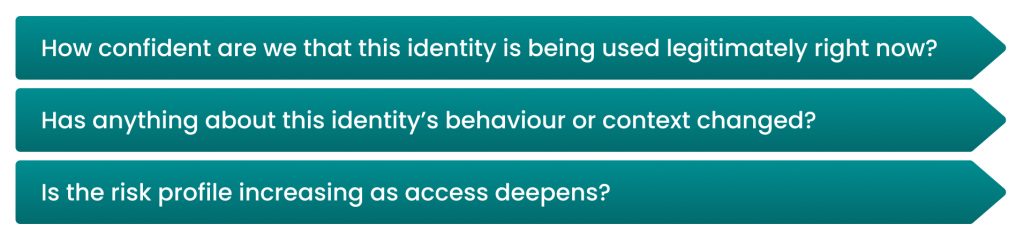
This shift — from static proof to dynamic confidence — is one of the biggest reasons the market is growing beyond basic KYC.
Sector-by-Sector Demand Is Deepening
While BFSI remains the largest driver, demand is widening across sectors:
Financial services need faster onboarding without increasing fraud exposure.
Fintech platforms need to scale trust at speed.
Marketplaces need to verify sellers, partners, and payouts.
Telecom needs reliable identity for activation and lifecycle management.
Healthcare and digital services need identity certainty without privacy overreach.
In each case, identity verification is no longer a one-time event. It’s part of the operating model.
Technology Is Reshaping What “Verification” Means
This market isn’t growing just because volumes are rising.
It’s growing because capabilities are changing.
AI and Automation
AI is enabling identity systems to move beyond yes/no decisions into probabilistic scoring — where multiple signals are weighed together to assess risk with nuance.
Signal Correlation
Documents, device data, behavioural cues, transaction context — none of these are decisive alone. Their value emerges when correlated.
Real-Time Decisions
Verification is increasingly expected to happen inline, not asynchronously — supporting instant onboarding and access without manual review.
These shifts make identity verification more accurate, faster, and harder to game — which is exactly what modern digital environments demand.
DPDP Has Changed the Tone of the Conversation
The Digital Personal Data Protection framework has subtly but decisively changed how identity verification is discussed inside organisations.
It’s no longer enough to ask:
“Can we verify this person?”
Now teams must also ask:
- Should we collect this data?
- For how long do we need it?
- Who has access?
- What happens if something goes wrong?
This has pushed identity systems toward:
- Minimal data exposure
- Clear consent flows
- Purpose-bound verification
- Strong internal controls
As a result, demand is shifting toward platforms and frameworks that treat privacy as part of verification — not a layer added later.
The Challenges Are Real — and Productive
This growth doesn’t come without friction.
Organisations struggle with:
- Balancing speed and safety
- Integrating legacy systems
- Interpreting complex verification outcomes
- Avoiding bias and false positives
- Scaling without increasing manual review
But these challenges are productive. They’re forcing better design, clearer standards, and more thoughtful use of technology.
Markets grow fastest when problems are hard — but solvable.
What This Expansion Really Signals
The rapid expansion of India’s identity verification market signals something deeper than regulatory compliance or digital growth.
It signals a shift in how trust itself is engineered.
Trust is no longer assumed.
It’s measured.
Maintained.
Re-evaluated.
Identity verification has become the mechanism through which digital systems decide when to believe, when to pause, and when to look closer.
Closing Thought
India’s identity verification market isn’t just getting bigger.
It’s getting more central.
As digital ecosystems grow more complex and interconnected, trust becomes infrastructure — invisible when it works, expensive when it fails.
The organisations that treat identity verification as a strategic capability rather than a compliance task will be the ones that scale with confidence.
Because in the end, growth doesn’t just require users.
It requires trust that can keep up.






Leave a Reply