
For decades, borrower risk assessment followed a familiar script.
An application comes in. A credit score is pulled. Maybe a few documents are reviewed. A decision is made based on a snapshot — a frozen moment of someone’s financial life, often built on data that’s weeks, months, or even years old.
It worked well enough in a slower world.
But we don’t live in that world anymore.
Today, income patterns shift faster, work is more flexible, and financial behavior leaves digital footprints in real time. Yet many lending decisions still lean heavily on backward-looking signals. The gap between how people actually live and how they are evaluated has never been wider.
That gap is where both risk and opportunity hide.
The Problem With Static Snapshots
Traditional credit assessment is built on history. Past loans. Repayment records. Credit utilization. These are important signals — but they tell you who a borrower was, not necessarily who they are right now.
Consider a gig worker whose income varies week to week. Or a small business owner who just landed a large contract. Or someone who switched jobs recently and doubled their salary. Static records may not reflect these changes for months.
On paper, they can look risky. In reality, they may be more stable than ever.
The opposite is also true. Someone with a clean historical record may have recently taken on unsustainable debt or lost a major source of income. By the time that shows up in traditional systems, the lender has already made a decision.
When data moves slowly, decisions lag behind reality.
Real Life Is Now Measured in Streams, Not Statements
Think about how financial behavior looks today.
Salaries don’t just come from one employer. Payments don’t just happen at bank counters. People earn through platforms, freelance work, side businesses, and digital marketplaces. They pay bills, transfer money, and manage subscriptions through apps that generate constant activity.
This creates a living trail of information — not to invade privacy, but to reflect financial rhythm. Cash flow patterns. Income consistency. Spending discipline. Repayment behavior across services.
Real-time data doesn’t replace traditional credit signals. It adds context. It answers questions that a three-digit score never could:
- Is this person’s income steady, even if it’s non-traditional?
- Are they managing their day-to-day obligations responsibly?
- Has their financial situation improved recently?
- Are there early signs of stress that don’t yet appear in formal records?
Instead of a still photograph, lenders get something closer to a short video clip of current financial health.
Risk Is No Longer Just About Defaults
In older models, borrower risk often meant one thing: the probability of default.
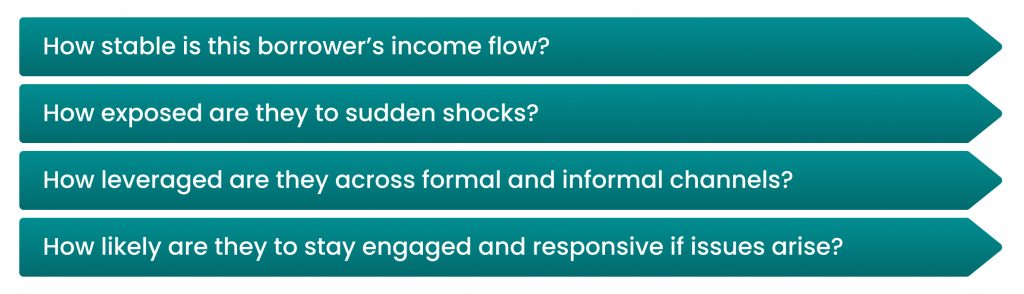
That’s still important. But modern risk assessment is becoming more nuanced. Lenders are asking:
- How stable is this borrower’s income flow?
- How exposed are they to sudden shocks?
- How leveraged are they across formal and informal channels?
- How likely are they to stay engaged and responsive if issues arise?
Real-time data helps answer these questions earlier. It highlights patterns — not just events.
For example, a gradual increase in short-term borrowing across multiple apps may signal rising financial strain, even if formal loan repayments are still on time. On the other hand, consistent inflows from diversified sources may show resilience, even when income isn’t tied to a traditional payslip.
Risk becomes less about a single red flag and more about the direction someone’s financial story is moving.
The Human Side of Better Data
There’s a quiet benefit to real-time risk assessment that doesn’t get talked about enough: fairness.
Traditional systems often disadvantage people with thin credit files — young professionals, new-to-credit individuals, gig workers, migrants, and small entrepreneurs. They may be financially responsible but lack the kind of history older models rely on.
Real-time signals can surface responsible behavior that would otherwise stay invisible. Regular bill payments. Stable digital income streams. Controlled spending patterns.
This doesn’t mean lowering standards. It means measuring people by how they actually operate today, not just by whether they fit legacy molds.
For lenders, this opens access to new, creditworthy segments. For borrowers, it feels less like being judged by a past they’ve already outgrown.
Speed Changes the Nature of Risk
Another shift is how quickly lending decisions now happen.
Digital lending journeys can move from application to disbursal in minutes. That convenience is powerful — but it compresses the window for risk evaluation. There’s less time for manual reviews, phone verifications, or document back-and-forth.
Real-time data fills that gap.
Instead of slowing down the process, it strengthens it in the background. Automated background checks can validate identity details, confirm account ownership, and assess financial behavior patterns almost instantly. Decisions remain fast, but they are no longer blind.
Speed without insight increases risk. Speed with live data creates smarter momentum.
Fraud and Misrepresentation Are Also Evolving
It’s not just genuine borrowers who benefit from faster systems. Fraudsters do too.
Static data is easier to manipulate because it changes slowly. Documents can be edited. Old records can be reused. Identities can be pieced together from leaked information.
Real-time verification adds friction in the right places. Live checks tied to current activity make it harder to rely on outdated or fabricated details. Behavioral patterns that don’t match claimed profiles can surface earlier.
Fraud risk doesn’t disappear, but it becomes harder to scale when decisions rely on dynamic signals instead of just static paperwork.
From One-Time Checks to Ongoing Awareness
Perhaps the biggest mindset shift is this: risk assessment is no longer a one-time event.
In traditional lending, most risk evaluation happens at onboarding. After that, monitoring is limited and often reactive — triggered when a payment is missed or a major issue arises.
With real-time data, lenders can move toward ongoing awareness. Not surveillance, but sensible monitoring of risk indicators over the life of the loan. Early warning signals can prompt timely nudges, restructuring offers, or support before problems spiral.
This approach is not only better for lenders; it can be better for borrowers too. Intervening early, with context, is far more constructive than reacting after default.
Technology Is Changing the Tools, Not the Responsibility
All of this said, more data does not automatically mean better decisions. Models can still be biased. Signals can be misread. Over-reliance on automation can create blind spots of its own.
The goal isn’t to replace human judgment but to inform it with fresher, richer inputs. Risk teams still need to ask hard questions. Compliance still matters. Transparency in how decisions are made becomes even more important when systems grow more complex.
Real-time data is a tool. Used well, it sharpens visibility. Used carelessly, it can overwhelm.
A More Current Picture of Borrower Reality
At its core, rethinking borrower risk in the age of real-time data is about one simple idea: aligning decisions with present reality.
People’s financial lives are more dynamic than ever. Income flows are fluid. Work is flexible. Digital behavior leaves timely, relevant signals about stability and stress. Holding on to purely static models in this environment is like driving forward while looking only in the rearview mirror.
The future of risk assessment isn’t about abandoning the past. It’s about balancing history with what’s happening now.
When lenders see borrowers as they are — not just as they once were — risk management becomes not only sharper, but more human.






Leave a Reply