
If you’ve ever filled out a business registration form, applied for GST, opened a current account, or tried onboarding as a seller on an e-commerce platform, one term always appears—TIN, or Tax Identification Number.
For something so common, TIN is surprisingly misunderstood. Many people still confuse it with GSTIN, PAN, VAT numbers, and state-level registration systems that existed before India’s tax reform. This guide simplifies everything—what TIN is, why it exists, who needs it, and how India’s tax identity system functions today.
And because the world of tax compliance is shifting fast—with AI-led verification systems, digital onboarding, and real-time API checks—we’ll also explore how modern businesses use automated identity verification tools like Gridlines to stay compliant and scale faster.
TIN Meaning: A Simple Definition
A Tax Identification Number (TIN) is a unique identifier assigned to individuals and businesses for tax-related purposes. Every country maintains some form of TIN so that its tax ecosystem can:
- Track taxpayers
- Prevent duplication and fraud
- Enable transparent financial reporting
- Support compliance and audits
In India, TIN historically referred to the VAT-based number issued by state authorities before GST came into existence. But post-2017, the structure changed dramatically.
TIN in India Today — What Has Changed?
After the rollout of GST, TIN as a VAT number was phased out. But the term “TIN” is still widely used worldwide, so understanding the Indian context is important.
Today, India primarily uses these identifiers:
1. PAN (Permanent Account Number)
- The universal tax identifier for individuals & businesses
- Required for income tax, high-value transactions, compliance filings, and financial accounts
2. GSTIN (Goods and Services Tax Identification Number)
- A 15-digit unique ID for businesses registered under GST
- Replaced the old state-wise TIN/VAT system
3. TAN (Tax Deduction and Collection Account Number)
- Issued to entities responsible for deducting or collecting TDS/TCS
So, while “TIN” is not technically issued anymore in India, PAN + GSTIN together form the effective tax identity framework for modern businesses.
Why Tax Identification Numbers Matter
Whether you’re a freelancer, startup founder, SME owner, or enterprise CFO, tax identity numbers play a critical role in the financial backbone of your operations. They help:
✔ Enable legal operations
You cannot run a business, open a current account, or sell online without proper tax IDs.
✔ Support transparency & audit trails
PAN and GSTIN form the basis of your audit trail across financial systems.
✔ Allow interstate & B2B trade
GSTIN is mandatory for issuing invoices, claiming ITC, and filing returns.
✔ Reduce fraud in the ecosystem
Tax IDs help platforms cross-verify businesses before onboarding.
✔ Build trust with banks, lenders & partners
Verification of tax details is a standard requirement for credit assessments and vendor onboarding.
In short: Tax identity numbers simplify compliance and protect the economy against fraud.
PAN vs GSTIN vs TAN — Quick Comparison
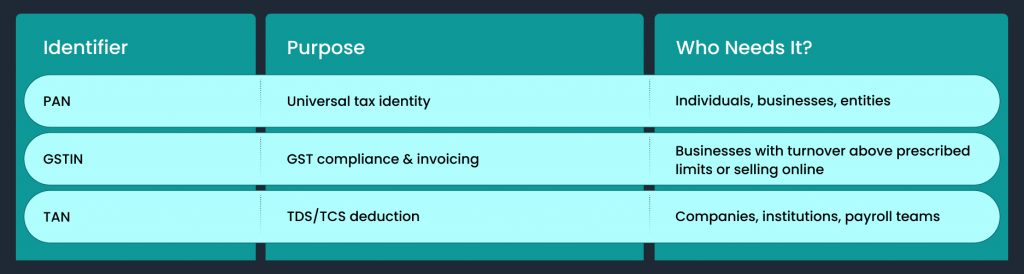
Each of these works together to create a layered identity structure for the Indian taxation system.
How AI & Digital Verification Are Transforming Tax Identity Validation
Earlier, validating tax numbers was manual—uploading documents, waiting for approvals, and dealing with errors. Today, platforms like Gridlines enable:
Real-time PAN verification using APIs
Businesses can instantly validate PAN against government sources.
GSTIN verification with status, filing history & registration details
Critical for vendor onboarding, seller marketplaces, and lending workflows.
Automated fraud detection using AI
AI models identify mismatched information, suspicious filing patterns, or identity inconsistencies.
Faster onboarding for gig workers, vendors, and SMEs
Real-time checks cut onboarding times from days to seconds.
Scalable compliance for large enterprises
Enterprises can verify thousands of partners or customers programmatically.
The result?
Higher trust, lower operational load, and a safer financial ecosystem.
Where TIN (or Tax ID) Is Required in India
Even though the old TIN is obsolete, tax identity numbers (PAN/GSTIN/TAN) are essential for:
- Business registration
- Opening current accounts
- Vendor onboarding
- Marketplace onboarding
- Loan applications
- KYC/KYB checks
- Filing income tax & GST returns
- Applying for trade licenses
- Export/import registrations
Every digital platform—from fintech apps to gig aggregators—now verifies these automatically.
How to Apply for PAN, GSTIN & TAN
1. Apply for PAN
- Via NSDL or UTIITSL
- Available for individuals, firms, companies & foreign entities
- Requires Aadhaar, identity proof, and address proof
2. Apply for GSTIN
- Through the GST portal
- Requires PAN, bank details, proof of business
- Verification is OTP + document-based
3. Apply for TAN
- Through NSDL’s portal
- Required for entities deducting TDS or TCS
Most processes are now digital and Aadhaar-enabled.
Common Problems People Face With Tax Identifiers
Even with digitisation, businesses frequently run into issues like:
- Wrong GSTIN linked to invoices
- PAN mismatch between legal name & registered name
- Suspended/unregistered GST numbers of vendors
- Duplicate business entities
- Fake or shell-company PANs used for scams
- Incorrect state jurisdiction under GST
These are exactly the issues solved by automated identity verification platforms.
Final Thoughts
The world of tax identity may feel complex, but its purpose is simple—to enable a transparent, trusted and compliant financial system. As India continues to digitise governance and financial services, PAN, GSTIN, and TAN form the backbone of identity verification for businesses and individuals.
With AI-led systems, real-time APIs, and automated checks, organisations can now onboard, verify and scale faster—while staying fully compliant.
Whether you’re a founder, a compliance head, or a product manager building onboarding flows—understanding how tax identity works gives you a massive edge.






Leave a Reply