
Identity verification has always been one of the most essential steps in onboarding customers—whether you’re opening a bank account, taking a small loan, signing up on an investment platform, or accessing regulated digital services. And for years, this process depended heavily on in-person visits, manual review, and long waiting periods.
Video KYC was the first major leap away from that. It allowed people to verify their identity remotely, without travelling to a branch. But even with this improvement, a familiar bottleneck remained: human agents.
If you’ve ever waited for a Video KYC call, you already know the experience—waiting in a queue, matching schedules with the agent, repeating instructions, facing call drops, and sometimes restarting the entire verification. Businesses also faced constraints because one agent could only handle a limited number of customers at a time.
This is where the next phase of digital verification is emerging:
Agentless Video KYC powered by smart consent and automated workflows.
It represents a shift from “video call + agent” to “guided video + automation”, and is already beginning to transform how identity verification happens at scale.
Understanding Agentless Video KYC
Agentless Video KYC is a fully self-serve verification journey. Instead of speaking to a human verifier, users complete the entire process through an automated video flow—on their own time and at their own pace.
The steps are intuitive, mobile-friendly, and designed for people who may not be familiar with complex apps or digital processes. It is built on simple ideas:
- A guided verification journey
- Secure consent collection
- Automated identity checks
- AI-driven validations
- Instant feedback loops
And because there is no live agent involved, the experience feels more like completing a simple online task than a formal verification exercise.
Why the Industry Is Moving Toward Agentless Journeys
Three big shifts are pushing businesses in this direction:
1. Customer Expectations Have Changed
Waiting for an agent feels outdated today. People expect onboarding to be instant—just like payments, food ordering, or ticket booking. A process that requires scheduling or waiting instantly increases the chance of drop-offs.
Agentless KYC solves this by being always available and always predictable.
2. The Need for Scale
Digital platforms—especially lending, fintech, and gig-economy services—onboard thousands of people every day. With human-led verification, scaling becomes expensive and slow. Automated verification removes the ceiling entirely.
3. Regulations Encourage Secure Digital Verification
As identity fraud becomes more sophisticated, regulators are encouraging secure, traceable, digital-first processes. Automated verification provides a clear audit trail and consistent evaluation, reducing the subjectivity of human judgment.
How an Agentless Video KYC Flow Typically Works
Every provider may structure it slightly differently, but the broad journey remains consistent.
1. The Customer Receives a KYC Link
A unique, secure link is generated when onboarding begins. This makes the process easy to initiate from any device.
2. Consent Is Captured Upfront
Before the verification starts, the user must explicitly approve the process. This ensures transparency and regulatory alignment.
3. The Guided Video Steps Begin
Instead of being asked questions on a live call, the user follows simple on-screen instructions. These may include:
- Recording a short video
- Capturing their ID document
- Completing basic liveness prompts
- Confirming personal details
Everything is framed in a way that feels simple and natural.
4. Automated Checks Get to Work
Once the user submits the video and documents, AI systems verify:
- Face match
- Liveness cues
- Document authenticity
- Data extraction and validation
- Possible inconsistencies
This happens in seconds, not minutes.
5. Businesses Get Real-Time Updates
Dashboards provide session status, drop-offs, completion rates, and history—helping companies monitor performance without manual follow-ups.
Real Benefits of Agentless and Automated Video KYC
For Businesses
- No dependence on agent availability
- Faster onboarding during peak demand
- Consistent, standardized evaluations
- Better fraud detection using AI-driven checks
- Lower operational cost per verification
- Ability to onboard users across multiple time zones
For Users
- No scheduling calls
- No queues or wait time
- A simple, mobile-first experience
- The ability to complete verification anytime—morning, night, weekdays, weekends
- A private, comfortable journey without the pressure of a live video call
For Compliance Teams
- Clean audit trails
- Automated MIS reports
- Timestamps, session logs, and evaluation data for every verification
- Reduced risk of manual oversight or inconsistent agent decisions
Agentless KYC vs. Traditional Models
While every organisation has its own process, the difference between traditional KYC models and automated video verification is clear.
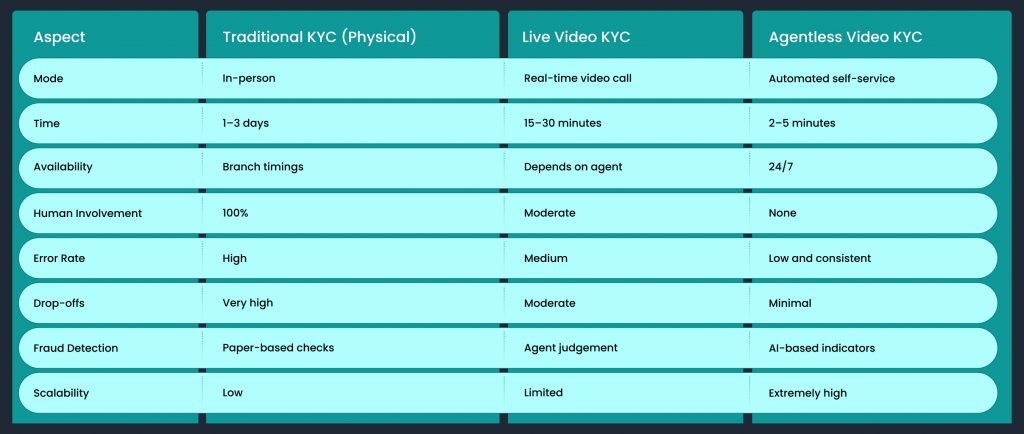
Agentless workflows don’t just improve speed—they fundamentally change the economics and reliability of verification.
Why Automated KYC Is Becoming the Default Choice for Digital Platforms
If you look at onboarding trends across fintech, lending, digital commerce, insurance, or gig platforms, a common pattern emerges:
- The number of users is increasing
- Verification complexity is rising
- Fraud attempts are more sophisticated
- Customers demand faster access
- Businesses must operate leaner
Automated video KYC addresses these challenges in a balanced way:
- It’s fast
- It’s secure
- It’s cost-efficient
- It’s built for scale
And importantly, it gives users autonomy—allowing them to complete verification in their own space, on their own time.
The Road Ahead
Agentless Video KYC is just the beginning. Over the next few years, we can expect:
- More advanced liveness checks
- Better detection of deepfakes or synthetic identities
- Tighter integration with national digital identity systems
- More automation in document verification
- Real-time cross-platform identity validation
- Reduction in manual KYCs across industries
As identity verification becomes more seamless, onboarding experiences across digital platforms will begin to match the ease and speed of everyday digital actions.
Conclusion
The future of Video KYC is not just “video-based”—it is automated, agentless, and guided by smart consent. It removes waiting rooms, reduces errors, and makes onboarding accessible to everyone, everywhere.
For users, it transforms a once formal, time-consuming task into something as simple as recording a quick video.
For businesses, it unlocks massive operational efficiency.
For the broader ecosystem, it strengthens the foundation of secure digital identity verification.
Agentless verification isn’t a trend—it’s becoming the new default for modern digital onboarding.






Leave a Reply