
Digital onboarding was meant to make life easier — faster account openings, smoother verification, and fewer in-person visits. But the same technology that enables convenience has also opened the door to a new kind of fraud: deepfake scams.
What used to be clumsy impersonation attempts have evolved into highly convincing fake videos, voices, and images generated using AI tools that are now widely accessible. For businesses that rely on remote identity checks, this creates a serious challenge. The person on camera may look real, speak naturally, and pass basic facial checks — yet not exist at all.
Deepfake fraud is no longer a futuristic concern. It’s a present-day risk for any organisation onboarding customers digitally. The good news? There are practical ways to stay ahead. Here are four that matter most.
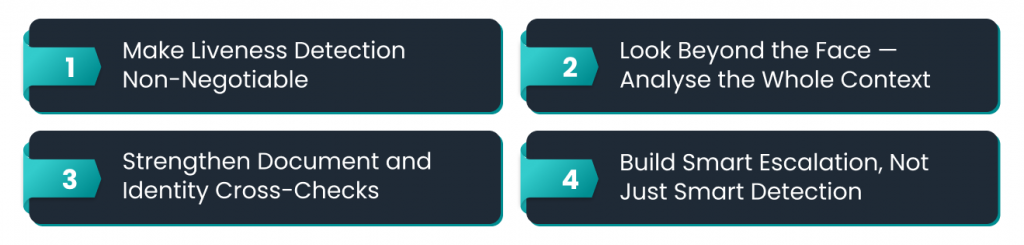
1. Make Liveness Detection Non-Negotiable
A static photo used to be the biggest threat to identity verification. Today, it’s a synthetic video.
Liveness detection is designed to confirm that there’s a real, physically present person in front of the camera — not a replayed clip, a screen recording, or an AI-generated face. But basic liveness checks aren’t enough anymore. Fraudsters test systems repeatedly to learn what movements or prompts are required, then train deepfake tools to mimic them.
Stronger liveness systems go beyond “blink and turn your head.” They analyse subtle depth cues, skin texture variations, light reflections, and micro-expressions that are extremely hard for synthetic media to reproduce accurately in real time. Some systems also introduce unpredictable prompts, making it difficult for pre-generated deepfake videos to keep up.
For onboarding teams, this means treating advanced liveness or face match not as an optional add-on but as a core security layer. If the system cannot confidently confirm a real person is present, the process should automatically step up to additional verification instead of pushing the application through.
2. Look Beyond the Face — Analyse the Whole Context
Deepfake prevention often focuses heavily on facial analysis, but fraud rarely exists in isolation. Suspicious activity tends to leave small signals across the entire onboarding journey.
For example, the device being used, the network connection, typing behaviour, and even how a document is uploaded can all offer clues. A perfectly clear face video paired with a high-risk device fingerprint or unusual location pattern should raise questions.
Behavioural signals are especially useful here. Humans interact with apps in natural, slightly inconsistent ways. Bots, scripts, or coordinated fraud attempts often show patterns that are too uniform or too fast. Combining these signals with biometric checks creates a more complete picture of risk.
In other words, deepfake detection works best when it’s part of a layered system. Instead of asking only “Does this face look real?”, organisations should be asking “Does this entire interaction look like normal human behaviour?”
3. Strengthen Document and Identity Cross-Checks
Deepfake scams during onboarding often go hand-in-hand with forged or manipulated documents. A synthetic face may be paired with a stolen identity number, an edited ID image, or mismatched personal details.
Relying purely on what a customer uploads is risky. Strong onboarding systems validate identity data against trusted sources and check for internal consistency. Does the name match across documents? Does the date of birth align with official records? Has this identity been linked to suspicious activity elsewhere?
Cross-verification helps catch cases where the video appears genuine but the underlying identity story doesn’t hold up. It also protects against synthetic identities built from fragments of real and fake information stitched together.
This approach shifts the focus from single-point checks to connected validation. Instead of trusting one piece of evidence, the system looks for a coherent, verifiable identity footprint. Deepfakes may be good at faking faces, but they often struggle to fake a consistent, traceable identity history.
4. Build Smart Escalation, Not Just Smart Detection
No detection system is perfect, and deepfake tactics continue to evolve. That’s why prevention doesn’t end with automated checks — it must include thoughtful escalation paths.
When the system spots anomalies — unusual facial artefacts, inconsistent behaviour patterns, or conflicting identity data — the response shouldn’t be an automatic rejection or a blind approval. Instead, high-risk cases should move to enhanced review.
This could mean additional live interaction with trained verification agents, secondary document checks, or alternative identity proof methods. The key is to apply friction selectively, where risk is higher, rather than slowing down every genuine customer.
Clear audit trails also matter. Organisations should be able to show why a case was flagged, what additional steps were taken, and how the final decision was reached. This not only strengthens internal governance but also builds confidence with regulators and partners.
Smart escalation ensures that when deepfakes slip past one layer, they are more likely to be caught at the next — without turning onboarding into a frustrating experience for legitimate users.
Why This Needs Ongoing Attention
Deepfake technology is improving quickly, and tools that once required specialised skills are now widely available. Fraudsters share techniques, test systems repeatedly, and adapt to known controls. That means prevention cannot be a one-time setup.
Organisations need regular reviews of their onboarding flows, detection models, and risk rules. What worked a year ago may now be too easy to bypass. Continuous tuning, monitoring fraud trends, and learning from flagged cases help keep defences relevant.
Equally important is internal awareness. Customer-facing teams, fraud analysts, and compliance professionals should understand what deepfake risk looks like and how layered controls work together. Technology is powerful, but informed people remain a crucial line of defence.
Staying Ahead Without Sacrificing Experience
The challenge with deepfake prevention is balancing security and convenience. Overly rigid processes can frustrate genuine customers and hurt conversion. Weak controls, on the other hand, invite fraud that damages trust far more severely.
The answer lies in intelligent, risk-based onboarding. Most users should experience a smooth, low-friction journey. Only when risk signals appear should the system introduce additional checks. When done right, strong deepfake prevention runs quietly in the background, protecting both the business and its customers.
Deepfake scams are a modern problem, but the principle behind stopping them is timeless: verify identity in a way that’s thorough, context-aware, and adaptable. By combining advanced liveness, behavioural insight, strong data cross-checks, and smart escalation, organisations can stay a step ahead of synthetic fraud — while keeping onboarding fast and trustworthy for real people.






Leave a Reply