
-
Merchant Onboarding: A Complete Guide to KYC, Risk Management & Payouts
Merchant onboarding is a critical step in building a trusted digital payments ecosystem. For banks, payment aggregators, payment gateways and merchant acquiring businesses, onboarding a merchant involves much more than collecting documents and activating a payment account. Businesses need to establish merchant identity, validate business credentials, assess potential risks and ensure that onboarding processes meet…
-
Video PD for Loans: Faster Borrower Assessment and Underwriting
A loan application can contain financial statements, identity documents, bank records and other supporting information. Yet, for many lending decisions, there is still a need to speak directly with the borrower. This conversation can help lenders understand the purpose of the loan, clarify information in the application and develop a better picture of the borrower’s…
-
Online Address Verification: A Faster, Remote Approach to Customer Onboarding
An address may seem like a straightforward detail to verify during customer onboarding. In practice, it can become one of the most time-consuming steps, particularly for banks, NBFCs, fintech companies and other businesses that rely on physical address verification. A field agent may need to visit the customer’s residence, coordinate a suitable time, collect evidence…
-
Loan Origination System Integration with KYC APIs
In India’s fast-growing digital lending ecosystem, speed, compliance, and trust are critical. Borrowers expect instant approvals, seamless experiences, and secure handling of their personal information. Lenders, on the other hand, need to manage regulatory requirements, mitigate fraud, and make accurate credit decisions. In this delicate balancing act, a Loan Origination System (LOS) integrated with KYC…
-
KYB in the Age of Instant Business Onboarding
There was a time when onboarding a business meant paperwork. Stamped incorporation certificates.Physical visits.Board resolutions couriered across cities.Bank statements printed and signed. It was slow. Sometimes frustrating. But thorough. Today, a small business can apply for a loan, open a payment gateway, or get onboarded onto a marketplace in under fifteen minutes. No branch visit.No…
-
Loan Stacking Fraud: Detection Strategies for NBFCs
Loan stacking rarely announces itself. There’s no dramatic system breach.No forged signature.No obvious identity theft. On paper, the borrower looks fine. The bureau score is acceptable.The income declaration seems reasonable.KYC checks pass. The loan gets approved. Three weeks later, repayment fails. What happened in between is what every NBFC in 2026 needs to understand. What…
-
UPI Fraud Trends: What Banks Need to Watch in 2026
There was a time when digital payment fraud meant card skimming. Then it meant phishing emails. Then it meant OTP theft. Now it means something subtler. It means social engineering that feels like customer service.It means mule accounts opened cleanly.It means fraud rings that understand UPI rails better than some bank teams do. The speed…
-

Video KYC for Lending Apps: Cut Drop-Off Without Risking Compliance
Every lending app eventually faces the same tension. On one side: growth.On the other: compliance. Marketing teams celebrate rising installs. Performance campaigns drive traffic at scale. Product dashboards show healthy loan applications started. And then — somewhere between document upload and identity verification — users disappear. Drop-off during KYC is one of the most expensive…
-
Top Signs of Fake Identities in Digital Platforms
Fake identities don’t arrive wearing masks. They arrive with perfectly formatted names, clean profile pictures, valid-looking phone numbers, and documents that pass at first glance. They behave like users. They transact like users. Sometimes, they even convert better than real users. And that’s exactly why they’re dangerous. Digital platforms today operate at massive speed. A…
-
Difference Between KYC, eKYC, and Video KYC
Same regulatory objective. Three very different execution models. If you work in fintech, lending, NBFCs, payments, or any regulated digital business, you’ve probably heard these terms used almost interchangeably: KYC, eKYC, Video KYC. They’re related. But they are not the same. And the difference isn’t just technical. It affects onboarding speed, fraud exposure, regulatory defensibility,…
-
Best Verification APIs for Lending Platforms in 2026
In 2026, lending platforms are no longer judged solely on underwriting models or interest rates. The real differentiator is trust — how reliably a platform can verify borrower identity, data authenticity, risk signals, and compliance in real time. Traditional verification mechanisms — manual document reviews, static KYC batches, email-based confirmations — can’t keep up with…
-

Asset Verification APIs for Sharing Economy Platforms
The sharing economy operates on distributed ownership. Vehicles are listed by individuals. Properties are rented peer-to-peer. Equipment, devices, warehouses, workspaces, and tools move through decentralized networks of suppliers. The platform facilitates the transaction — but it does not control the asset. Yet the platform carries the risk. Fraudulent listings, expired compliance, ownership disputes, asset misrepresentation,…
-
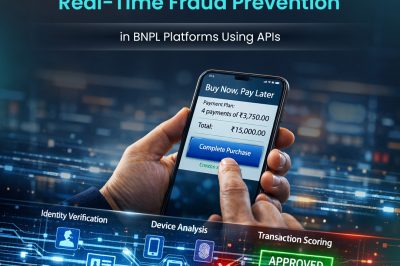
Real-Time Fraud Prevention in BNPL Platforms Using APIs
Buy Now, Pay Later didn’t grow slowly. It exploded. From checkout pages on fashion websites to electronics marketplaces and travel portals, BNPL has quietly embedded itself into everyday spending behavior. For customers, it feels frictionless. For merchants, it boosts conversion. For platforms, it unlocks scale. But underneath that smooth checkout button sits a hard reality:…