
-
Merchant Onboarding: A Complete Guide to KYC, Risk Management & Payouts
Merchant onboarding is a critical step in building a trusted digital payments ecosystem. For banks, payment aggregators, payment gateways and merchant acquiring businesses, onboarding a merchant involves much more than collecting documents and activating a payment account. Businesses need to establish merchant identity, validate business credentials, assess potential risks and ensure that onboarding processes meet…
-
Video PD for Loans: Faster Borrower Assessment and Underwriting
A loan application can contain financial statements, identity documents, bank records and other supporting information. Yet, for many lending decisions, there is still a need to speak directly with the borrower. This conversation can help lenders understand the purpose of the loan, clarify information in the application and develop a better picture of the borrower’s…
-
Online Address Verification: A Faster, Remote Approach to Customer Onboarding
An address may seem like a straightforward detail to verify during customer onboarding. In practice, it can become one of the most time-consuming steps, particularly for banks, NBFCs, fintech companies and other businesses that rely on physical address verification. A field agent may need to visit the customer’s residence, coordinate a suitable time, collect evidence…
-

How Lenders Verify Borrower Identity
Lending has always been about trust. A borrower applies. The lender evaluates. A decision is made—often quickly, sometimes instantly. But behind that decision sits a critical layer that rarely gets attention: identity. Because before credit risk, before underwriting, before approval—there’s a more fundamental question: Is this person who they claim to be? That’s where borrower…
-
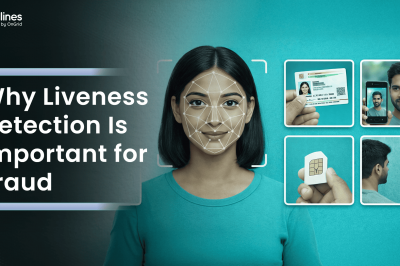
Why Liveness Detection Is Important for Fraud Prevention
There was a time when identity verification felt enough. If the document looked real and the face matched, the job was done. Most systems were built around that assumption—verify the ID, match the photo, move ahead. That assumption doesn’t hold anymore. Fraud hasn’t disappeared. It has evolved. Today, attackers don’t always fake identities. They use…
-

9 GST Verification Issues for Businesses
GST verification looks simple on the surface. Enter a GSTIN, check the details, confirm the status—and move on. But in real workflows, it rarely stays that clean. As businesses scale vendor onboarding, merchant verification, or partner due diligence, small inconsistencies in GST data start creating delays, confusion, and sometimes risk. What looks like a quick…
-
Top 6 DPDP Act Implications for KYC
For years, KYC has been straightforward—collect documents, verify identity, store records, move on. But that model is starting to feel outdated. The DPDP kyc impact changes the lens completely. KYC is no longer just about verification. It’s about how you collect data, why you collect it, and what you do with it after. That shift…
-
5 Problems Faced by NBFCs in KYC
There’s a point where onboarding starts to feel slower than it should. Applications are coming in, demand is there, but approvals aren’t moving at the same pace. Customers drop off midway, ops teams get stuck in loops, and what should be a quick process starts stretching out. At the center of this is a recurring…
-
What Is CKYCRR? Meaning, Functions, and 2026 Guide
If you’ve ever gone through KYC while opening a bank account, applying for a loan, or investing in a financial product, you’ve probably wondered why you have to submit the same documents again and again. Same ID. Same address proof. Same verification—just a different platform. That repetition is exactly what CKYCRR was designed to fix.…
-

Business Verification in 2026: Is the Company Legit?
There’s a quiet shift happening in how businesses trust other businesses. Earlier, legitimacy was assumed. A company had a website, a GST number, maybe a few documents—and that was enough to move forward. In 2026, that’s no longer the case. Today, every partnership, every vendor onboarding, every merchant signup starts with a more fundamental question:…
-

Searching for a Business Registration Number? Here’s How
Most teams assume that a “Business Registration Number” is a standard, universally issued ID. It’s not. And that misunderstanding often leads to messy verification workflows, mismatched records, and unnecessary back-and-forth during onboarding. In reality, the concept of a Business Registration Number is broader—and in some cases, more structured—than it first appears. If you’re working with…
-

7 KYC Challenges in Lending Apps
Most lending teams don’t think of KYC as a growth problem. They think of it as compliance. A necessary checkpoint. Something that needs to be “done right” before anything else moves. But if you look closely, KYC is where growth is either unlocked—or quietly blocked. Every delay in verification is a lost application.Every friction point…
-

6 Challenges in Digital Merchant Onboarding
Merchant onboarding used to be a paperwork-heavy, back-office function. Today, it’s a frontline growth lever. Every payment gateway, lending platform, or marketplace is in a race to onboard more merchants, faster. But speed alone isn’t enough. If onboarding is rushed or poorly designed, it opens the door to fraud, compliance issues, and long-term operational headaches.…