
-
Merchant Onboarding: A Complete Guide to KYC, Risk Management & Payouts
Merchant onboarding is a critical step in building a trusted digital payments ecosystem. For banks, payment aggregators, payment gateways and merchant acquiring businesses, onboarding a merchant involves much more than collecting documents and activating a payment account. Businesses need to establish merchant identity, validate business credentials, assess potential risks and ensure that onboarding processes meet…
-
Video PD for Loans: Faster Borrower Assessment and Underwriting
A loan application can contain financial statements, identity documents, bank records and other supporting information. Yet, for many lending decisions, there is still a need to speak directly with the borrower. This conversation can help lenders understand the purpose of the loan, clarify information in the application and develop a better picture of the borrower’s…
-
Online Address Verification: A Faster, Remote Approach to Customer Onboarding
An address may seem like a straightforward detail to verify during customer onboarding. In practice, it can become one of the most time-consuming steps, particularly for banks, NBFCs, fintech companies and other businesses that rely on physical address verification. A field agent may need to visit the customer’s residence, coordinate a suitable time, collect evidence…
-
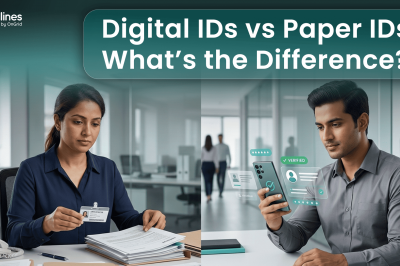
Digital IDs vs Paper IDs: What’s the Difference?
Picture this: a compliance officer at a fast-growing NBFC in Hyderabad gets 400 loan applications in a single week. Half of them come with scanned copies of Aadhaar and PAN. The other half link directly to DigiLocker-verified documents pulled in real time. Both sets look identical to the untrained eye. But the risk profile? Completely…
-
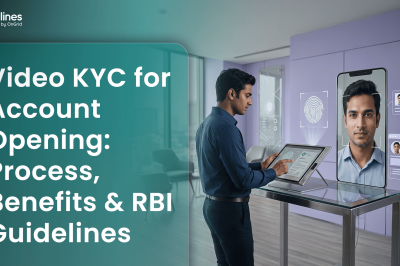
Video KYC for Bank Account Opening: Process, Benefits & RBI Guidelines
Walk into a bank branch to open an account today, and you’ll probably spend the better part of an afternoon doing it. Fill out a form, submit photocopies, wait for a relationship manager, sign three places, wait some more. It’s 2026, and parts of this experience still feel like 2006. That’s precisely the gap that…
-

What is APAAR ID? Full Form, Benefits & How to Register in 2026
If you’ve been paying even the slightest attention to education news in India over the past couple of years, you’ve probably stumbled across the term APAAR ID. Maybe your child’s school sent home a circular asking parents to consent. Maybe a teacher mentioned it in passing. Or perhaps you just saw it trending on social…
-

What Is CRILC? Meaning, and Its Role in Risk Management
What Is CRILC? If you’ve worked anywhere close to lending, credit underwriting, or risk, you’ve likely heard the term CRILC in passing—usually in the same breath as defaults, stress accounts, or regulatory reporting. But CRILC isn’t just a compliance checkbox. It quietly powers one of the most important shifts in how India’s financial system tracks…
-

When Seeing Isn’t Believing: The Rising Risk of AI Generated Fraud
A screenshot of a cheque circulated on social media recently. Rs 69,000. Clean handwriting, proper formatting, the kind of document you’d glance at and move on from without a second thought. Except it was entirely AI-generated. No bank issued it. No one signed it. No transaction ever took place. It was generated in seconds using…
-
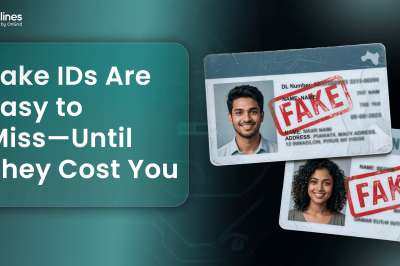
Fake IDs Are Easy to Miss—Until They Cost You
There’s a moment in every onboarding journey that feels routine.A document is uploaded. The details look clean. The format checks out. And the system moves forward. This is where most mistakes begin. Fake IDs today aren’t obvious. They don’t come with spelling errors or broken layouts. They look legitimate, often indistinguishable from real documents at…
-
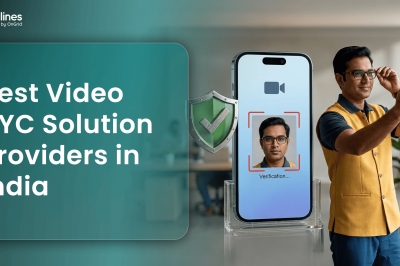
Best Video KYC Solution Providers in India
Video KYC in India has evolved from a compliance requirement to a critical part of user onboarding. What used to be a simple identity check is now a complex interaction shaped by network conditions, device limitations, and rising fraud risks. In such an environment, choosing the best video KYC solution providers in India isn’t about…
-
How to Update Aadhaar Address Using Mobile App
Shifting to a new home often comes with a long checklist. Somewhere between setting up Wi-Fi and updating bank details, your Aadhaar address quietly gets ignored. Until it starts causing problems. A failed KYC, a delayed application, or a mismatch during verification—these are usually the moments when the old address becomes an issue. The good…
-

Top 8 Factors That Impact Your CIBIL Score
There’s a moment most people remember clearly—the first time a loan gets delayed, a credit card gets rejected, or an interest rate suddenly feels higher than expected. And almost always, the reason traces back to one number: your CIBIL score. But here’s what’s interesting. Most people know their score matters. Very few actually understand why…
-

What is Deepfake AI? Meaning, Risks, and Real-World Impact Explained
There was a time when seeing was believing. A photograph, a video, a voice recording—these were treated as proof. Today, that assumption is quietly breaking down. Enter deepfake AI, a technology that can convincingly fabricate reality, often so seamlessly that even trained eyes struggle to tell what’s real and what isn’t. Let’s unpack what deepfake…